
Introduction: The New Standard for Consumer Packaged Goods
Building a successful consumer packaged goods (CPG) brand in 2026 requires a total overhaul of legacy financial models. High consumer acquisition costs, supply chain shifts, and retail demands have made thin margins fatal.
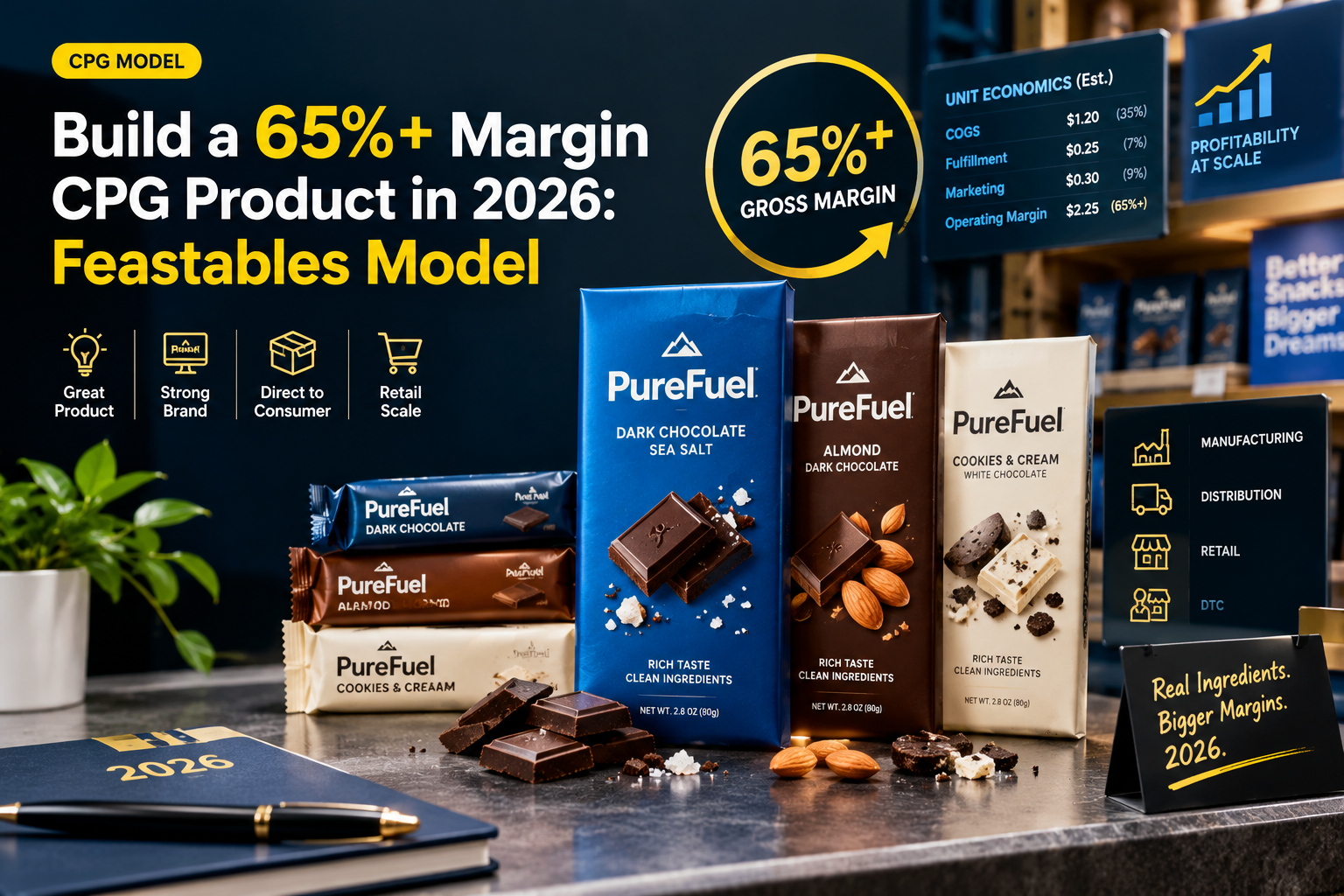
If you want to Build a 65%+ Margin CPG Product in 2026, you must study how modern titan brands like Feastables engineered their supply chain from day one. Feastables disrupted the confectionery landscape by combining viral creator marketing with unmatched operational efficiency.
In this guide, we break down the exact financial engineering, co-packer negotiation strategies, and formulation frameworks needed to build a hyper-profitable food or beverage product today.
Decoding the Feastables Unit Economics Model
Achieving a 65%+ gross margin before trade spend is not an accident. It is the result of deliberate product design, strict bill of materials (BOM) management, and strategic pricing.
Legacy CPG brands often launch with 40% to 50% gross margins, assuming scale will solve their profitability problems. However, retailer margin cuts, slotting fees, and distributor bites quickly erode those thin profits into negative territory.
By benchmarking your numbers against top viral brands, you can establish baseline economics that guarantee long-term viability across both direct-to-consumer (DTC) and retail channels.
Bill of Materials (BOM) Breakdown
Your Bill of Materials is the foundational foundation of your gross margin calculation. To reach 65%+ gross margins, your primary product costs must stay strictly under 35% of your wholesale or retail selling price.
Here is how a target $3.99 retail chocolate bar or snack unit breaks down in a best-in-class 2026 CPG model:
- Raw Ingredients: $0.35 – $0.45 per unit (incorporating high-grade cacao or specialty bases)
- Primary & Secondary Packaging: $0.15 – $0.22 per unit (flow wrap, display boxes, eco-friendly foils)
- Co-Packing Toll Fees: $0.20 – $0.30 per unit (manufacturing labor and line time)
- Inbound Freight: $0.05 – $0.08 per unit (shipping raw materials to contract manufacturer)
- Total Landed COGS: $0.75 – $1.05 per unit
When sold at a retail MSRP of $3.49 to $3.99, a landed COGS of $0.90 yields an impressive 74% gross margin at the brand manufacturer level. This provides sufficient cushion for distributor margins (typically 25-30%) and retail buyer margins (typically 35-40%).
DTC vs. Retail Margin Compression
Selling direct-to-consumer offers high gross margins, but customer acquisition costs (CAC) on paid social channels can eliminate net profit. Conversely, retail offers volume, but introduces severe channel friction.
Understanding consumer demographics is critical when designing your product’s price point and sales channel mix. For instance, understanding how Generation Z consumers make purchasing decisions helps brands craft high-velocity products that sell naturally off retail shelves without heavy paid ad reliance.
“Gross margin is your breathing room. If you start with 50% gross margins, retail trade spend and distributor chargebacks will leave you with zero net cash flow.”
Step-by-Step Co-Packer Sourcing Framework
Your choice of contract manufacturer (co-packer) dictates your product quality, scalability, and baseline cost structure. Finding the right production partner requires a disciplined sourcing framework.
In 2026, top-tier co-packers prioritize high-volume brands with clean operational processes. You must approach co-packers as a serious partner rather than just another customer requesting quotes.
Follow this three-phase blueprint to source, audit, and negotiate with world-class co-packing facilities.
Identifying Tier-1 Contract Manufacturers
Begin by building a broad database of potential manufacturing partners through industry databases such as the Contract Packaging Association. Filter your list by specialized equipment requirements, geographic location, and food safety certifications.
Ensure any factory you consider possesses updated global safety accreditations:
- SQF (Safe Quality Food) Level 2 or 3: Essential for nationwide retail distribution.
- BRCGS Certification: Benchmark global standard for food safety and operational quality.
- FDA Registration & HACCP Compliance: Mandatory baseline compliance standards mandated by the U.S. Food and Drug Administration.
Working with uncertified co-packers might seem cheaper initially, but it exposes your CPG brand to massive recall risks and disqualifies you from major retail accounts like Target or Walmart.
Negotiating Minimum Order Quantities (MOQs) & Payment Terms
New brands frequently fail due to capital tied up in massive initial minimum order quantities (MOQs). To preserve early-stage cash flow, negotiate tiered pricing strategies based on volume milestones.
Instead of accepting a flat 100,000-unit MOQ, propose a phased rollout model:
- Initial Pilot Run: 15,000 to 25,000 units at a slightly higher toll fee to validate formulation on automated lines.
- Commercial Scale Run: 50,000+ units with discounted line fees upon achieving quality compliance targets.
- Payment Term Escalation: Move from 50% deposit / 50% pre-shipment terms to Net-30 or Net-60 payment terms within your first 6 months of prompt payments.
Ingredient Formulation and Supply Chain Optimization
Formulation directly dictates your cost structure and consumer repeat purchase rates. To maintain high margins without sacrificing product taste or quality, you must leverage value-engineering techniques early in R&D.
External economic headwinds, including shifting agricultural trends and rising global ingredient prices, require brands to build flexible formulas that adapt to raw material volatility.
Work with experienced food scientists who understand high-speed manufacturing limitations and commercial ingredient costs.
Value Engineering Without Sacrificing Flavor
Value engineering involves optimizing raw ingredient blends to reduce unit costs while preserving sensory experience. For example, replacing expensive organic specialty inclusions with scalable, non-GMO functional equivalents can cut ingredient costs by 20% to 30%.
Key strategies for ingredient optimization include:
- Simplifying Ingredients: Feastables succeeded by focusing on simple, clean ingredient decks (e.g., 4 to 6 core ingredients), which significantly simplified sourcing and reduced waste.
- Standardizing Packaging Dimensions: Custom-shaped packaging creates high tooling costs and line slowdowns. Standard film roll dimensions fit existing automated packaging machinery easily.
- Bulk Commodity Sourcing: Lock in 6-month or 12-month forward contracts for key commodities to protect against sudden market spikes according to market intelligence reports on Statista CPG market dynamics.
Marketing, Distribution, and Retail Execution in 2026
Even with optimal unit economics, a brand cannot succeed without hyper-efficient distribution and customer capture strategies. High product velocity on store shelves is what unlocks scale-based cost savings with your co-packer.
Modern creator-led CPG brands don’t rely on traditional multi-million dollar ad campaigns. Instead, they engineer viral marketing systems directly into their product launches.
To drive rapid retail turn rates, combine viral organic content hooks with strategic trade promotions.
Harnessing Creator Media and Viral Content Hooks
Digital native audiences expect entertainment alongside their purchases. Brands can build massive brand equity by creating high-retention video content that drives immediate foot traffic to retail stores.
Understanding online content systems allows CPG founders to generate free exposure. Leveraging tools that help brands auto-generate viral retention hooks can dramatically increase top-of-funnel customer interest for direct sales and retail drops.
Navigating Distributor Margins and Trade Spend
When entering national retail chains via distributors like UNFI or KeHE, your financial model must account for extra operational costs beyond basic COGS.
Budget for these essential trade spend line items in your financial model:
- Distributor Margin: 15% to 25% markdowns off wholesale prices.
- Retailer Slotting Fees: Upfront fees charged by grocers to secure shelf placement.
- Promotional Scans & Demos: Temporary price reductions (TPRs) and in-store sampling events to maintain high sales velocity.
- Spoilage and Damage Allowances: Standard 1% to 2% deductions for damaged goods during transit.
Conclusion: Your Roadmap to Build a 65%+ Margin CPG Product in 2026
Building a high-margin, hyper-scalable CPG business in 2026 requires an unwavering commitment to operational excellence, strategic sourcing, and smart financial modeling.
By controlling your packaging costs, vetting certified co-packers, and maintaining short ingredient decks, you can successfully Build a 65%+ Margin CPG Product in 2026 that thrives across both retail and digital channels.
Focus on unit economics from day one. Protect your cash flow, optimize your supply chain, and build a brand that delivers genuine value to modern consumers.
Frequently Asked Questions (FAQs)
What is a good gross margin for a new CPG product in 2026?
A healthy gross margin for a startup CPG brand in 2026 is 60% to 70% at wholesale/MSRP baseline. This leaves enough margin buffer to absorb distributor cuts (25-30%), retailer margins (35-40%), and trade spend fees.
How did Feastables achieve such rapid growth and profitability?
Feastables combined viral creator-led marketing with a simplified 4 to 6 ingredient formulation deck, allowing for high-speed automated manufacturing, lower landed COGS, and rapid retail sell-through rates.
What key certifications should I look for in a food co-packer?
You should look for SQF (Safe Quality Food) Level 2 or 3, BRCGS Certification, and full FDA Registration with HACCP compliance. These ensure your brand can enter major national retailers seamlessly.
How do I negotiate lower MOQs with a contract manufacturer?
Offer a phased volume agreement where you pay a slightly higher unit toll fee for an initial 15,000 to 25,000 unit pilot run, with agreed price reductions as your order volumes reach higher tiers.
2 thoughts on “Build a 65%+ Margin CPG Product in 2026: Feastables Model”