Quantum computing sounds like something out of science fiction.
You’ve probably heard things like:
- “It’s 1000x faster than normal computers”
- “It will change the world”
- “It can break encryption”
But what does it actually mean?
Let’s break it down in a way that’s clear, practical, and useful.
Quick Answer: What Is Quantum Computing?
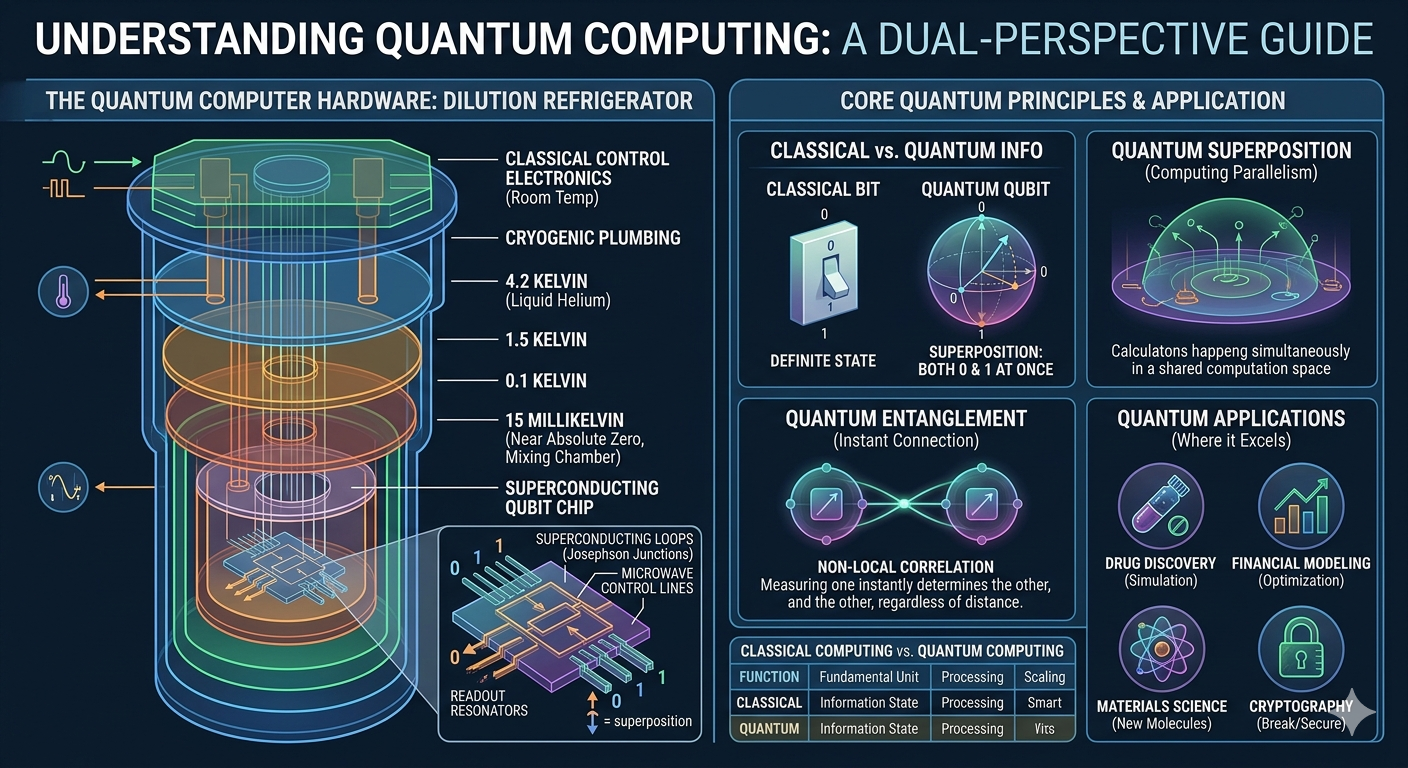
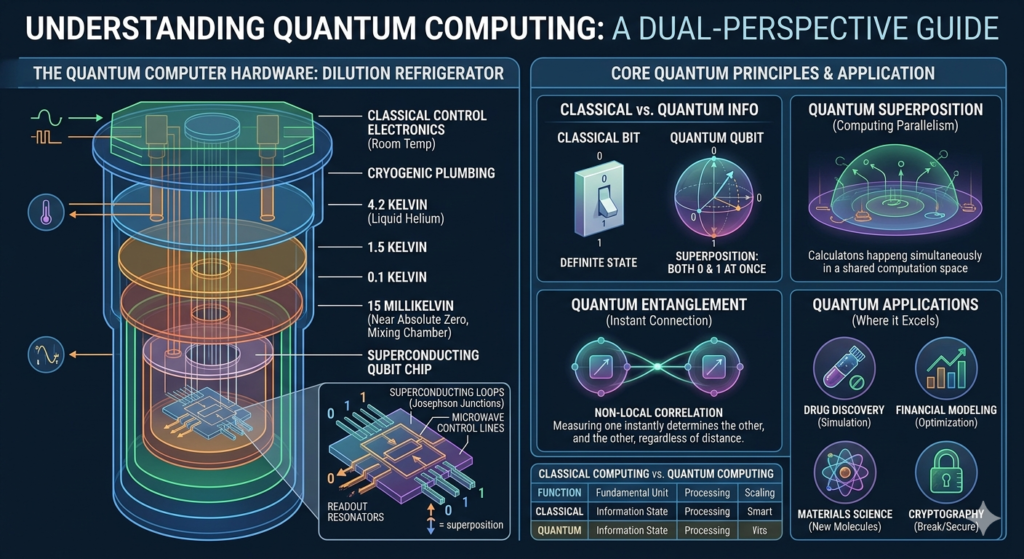
Quantum computing is a new type of computing that uses the principles of Quantum Mechanics to process information in a fundamentally different way than traditional computers.
Instead of using bits (0 or 1), it uses qubits, which can be:
- 0
- 1
- Or both at the same time
👉 This allows quantum computers to solve certain problems much faster.
How Normal Computers Work (Simple Understanding)
Traditional computers (your phone, laptop) use:
- Bits → 0 or 1
- Step-by-step processing
Example:
To solve a problem, a normal computer checks one possibility at a time.
How Quantum Computers Work
Quantum computers use:
- Qubits
- Superposition
- Entanglement
These come from Quantum Mechanics.
1. Superposition (The Big Idea)
A qubit can be:
- 0
- 1
- Both at the same time
👉 This means quantum computers can explore many possibilities at once.
2. Entanglement (Strange but Powerful)
Qubits can be connected in a way that:
- Changing one instantly affects another
👉 This allows extremely complex calculations.
Why Quantum Computing Is So Powerful
Instead of solving problems step-by-step, quantum computers:
Explore multiple solutions simultaneously
This makes them useful for:
- Complex simulations
- Optimization problems
- Cryptography
Real-World Example (Simple)
Imagine you’re trying to find the fastest route through 1,000 cities.
- Normal computer → checks routes one by one
- Quantum computer → evaluates many routes at once
👉 Result: Faster solutions for complex problems.
Real Companies Working on Quantum Computing
Some of the biggest tech companies are investing heavily:
- IBM
- Microsoft
Example Breakthrough
In 2019, Google claimed “quantum supremacy”:
- A quantum computer solved a problem
- That would take traditional computers thousands of years
👉 This showed real potential.
What Can Quantum Computers Be Used For?
1. Medicine & Drug Discovery
- Simulate molecules
- Speed up research
2. Finance
- Risk analysis
- Portfolio optimization
3. Cybersecurity
- Break current encryption
- Create new secure systems
4. Artificial Intelligence
- Improve machine learning models
Is Quantum Computing Available Today?
👉 Yes—but limited.
Right now:
- Mostly used in research labs
- Not widely available for everyday use
Some companies (like IBM) offer limited cloud access.
The Challenges of Quantum Computing
It’s not all hype—there are real problems:
- Extremely fragile systems
- Requires near-zero temperatures
- High cost
- Error rates are still high
👉 That’s why it’s still developing.
Quantum Computing vs Classical Computing
| Feature | Classical Computer | Quantum Computer |
|---|---|---|
| Data unit | Bit (0 or 1) | Qubit (0, 1, both) |
| Speed | Linear | Exponential (for some tasks) |
| Use cases | Everyday tasks | Complex problems |
The Future of Quantum Computing
Experts believe:
- It won’t replace normal computers
- It will work alongside them
👉 Think of it as a specialized tool for difficult problems.
The Reality Most People Misunderstand
Quantum computing is not:
- A faster version of your laptop
- Something you’ll use daily (yet)
It is:
- A breakthrough technology for specific industries
Final Verdict
Quantum computing is a powerful new way of solving problems—but it’s still in its early stages.
Key Takeaway
Quantum computing doesn’t just do things faster—it solves problems differently.
FAQs
Is quantum computing real?
Yes, it’s already being developed by companies like IBM and Google.
Will quantum computers replace normal computers?
No, they will work alongside traditional systems.
Why is quantum computing important?
Because it can solve problems that are impossible for classical computers.