When I first encountered the term “quantum computing”, I’ll admit it—it sounded like something straight out of science fiction. Qubits, superposition, entanglement… it was overwhelming.
But after diving into the basics, I realized quantum computing for beginners is not as complex as it seems. And once you understand the key concepts, you’ll see why it has the potential to revolutionize industries. So let’s break it down in simple terms.
What Is Quantum Computing for Beginners?
In simple terms, quantum computing is a type of computing that leverages the strange properties of quantum mechanics (the physics of the tiniest particles, like atoms and photons) to process information in a fundamentally different way from the computers we use every day.
Traditional Computing vs Quantum Computing
- Traditional Computers: Use bits (0s and 1s) to store and process data.
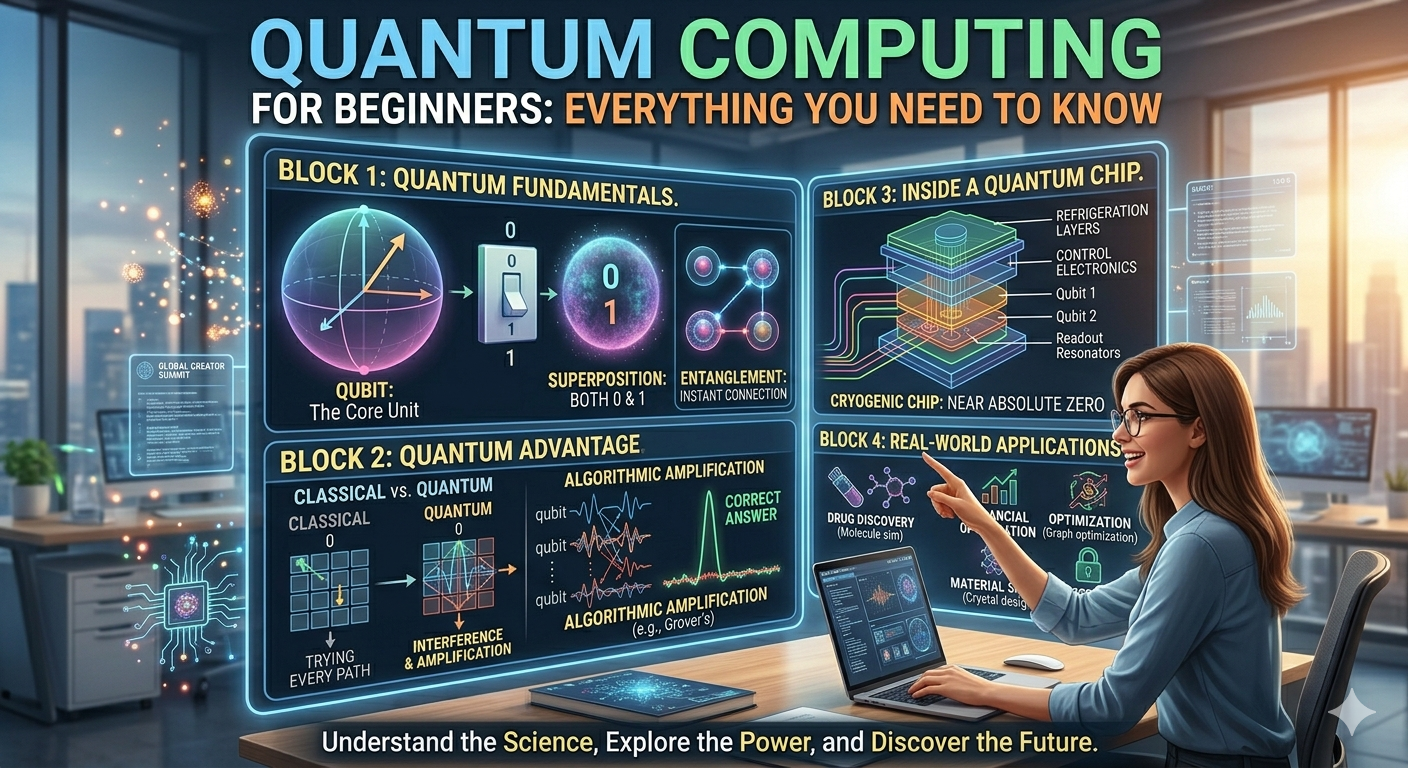
- Quantum Computers: Use qubits, which can exist as 0, 1, or both simultaneously, thanks to a phenomenon known as superposition.
That’s the foundational difference. It’s what makes quantum computers exponentially more powerful when it comes to solving certain kinds of complex problems.
The Key Concepts of Quantum Computing for Beginners
Let’s break down the main concepts that make quantum computing work:
1. Qubits – The Building Blocks of Quantum Computers
In classical computing, bits are the smallest unit of information—they’re either a 0 or a 1.
In quantum computing, we use qubits. But here’s the thing: Unlike regular bits, qubits can be both 0 and 1 at the same time. This is known as superposition.
Why does this matter?
Because it means quantum computers can explore multiple possibilities at once, making them much faster and more efficient for certain tasks.
2. Superposition – Multiple States at Once
Superposition is what allows qubits to be in multiple states simultaneously. Imagine being able to check every possibility of a puzzle at the same time instead of one by one. That’s superposition at work.
For example:
- If you had a regular computer, it would check every path in a maze one at a time.
- A quantum computer can analyze all the paths simultaneously and quickly determine the best route.
3. Entanglement – Instant Connections
Now, here’s where things get really weird. In quantum computing, entanglement occurs when two qubits become linked. When one qubit is changed, the other will change immediately, no matter how far apart they are.
This allows quantum computers to perform incredibly complex calculations faster than traditional systems, making them perfect for things like optimization problems and data simulations.
Why Quantum Computing Matters for Beginners
So why should we care about quantum computing for beginners? Because it has the potential to solve problems that current computers can’t. Here are a few areas where quantum computing will change the game:
1. Healthcare – Accelerating Drug Discovery
Quantum computers will be able to simulate molecules and reactions in ways that are too complex for traditional computers. This will lead to breakthroughs in drug discovery and disease treatment.
2. Finance – Optimizing Complex Systems
From portfolio optimization to risk analysis, quantum computing can process vast amounts of data and find the best solutions much faster than current computers.
3. Cybersecurity – Reinventing Encryption
While quantum computers could eventually break current encryption methods, they can also create ultra-secure encryption systems that are nearly impossible to hack, paving the way for the future of cybersecurity.
4. Artificial Intelligence – Improving Algorithms
Quantum computing will accelerate AI by allowing it to process massive amounts of data more efficiently and find patterns more quickly, improving everything from self-driving cars to predictive analytics.
How Quantum Computing for Beginners is Being Used Today
Although quantum computers aren’t ready for consumer use just yet, companies like IBM, Google, and Microsoft are already making strides. In 2019, Google achieved “quantum supremacy,” meaning their quantum computer solved a problem in 200 seconds that would take the most advanced classical computer 10,000 years to solve.
Currently, most quantum computing is happening in research labs, but quantum computing cloud platforms like IBM Quantum are opening up access to developers, scientists, and engineers to experiment with quantum algorithms.
The Challenges of Quantum Computing for Beginners
Here’s the reality: quantum computing is still in its early stages. Some of the main challenges include:
- Fragility: Qubits are very sensitive and can be easily disrupted by their environment.
- Error rates: Due to quantum noise, quantum computers still make many mistakes.
- Cost: Building and maintaining a quantum computer is incredibly expensive.
But these challenges don’t mean quantum computing won’t be a game-changer. Experts are working hard to improve the technology.
The Future of Quantum Computing for Beginners
So, what does the future hold?
- Quantum computing will complement classical computing, not replace it. Quantum computers are better at solving specific, complex problems, while traditional computers handle everyday tasks.
- Over the next few years, we’ll likely see more practical applications in industries like finance, healthcare, and manufacturing.
- As technology matures, it’s expected that quantum computers will become more accessible to businesses and researchers, leading to breakthroughs we can’t even predict yet.
Conclusion: Quantum Computing for Beginners
Quantum computing for beginners doesn’t have to be a mysterious or intimidating topic. At its core, it’s about harnessing the strange properties of quantum mechanics to solve problems in a new and powerful way.
Quantum computers are not here to replace our laptops, but they are here to solve problems that today’s computers cannot handle.
It’s an exciting time for quantum computing, and while it’s still early in the game, understanding the basics is the first step in preparing for the future.
FAQs About Quantum Computing for Beginners
What exactly is quantum computing for beginners?
Quantum computing is a new type of computing that uses qubits to process data, making it capable of solving complex problems much faster than traditional computers.
Do I need to be a physicist to understand quantum computing?
No! While quantum mechanics is based on physics, you can understand quantum computing at a basic level without a scientific background. This guide covers the basics for beginners.
Can quantum computers replace my current computer?
No, quantum computers are designed for specific tasks like simulations, optimizations, and data analysis. They will complement traditional computers, not replace them.